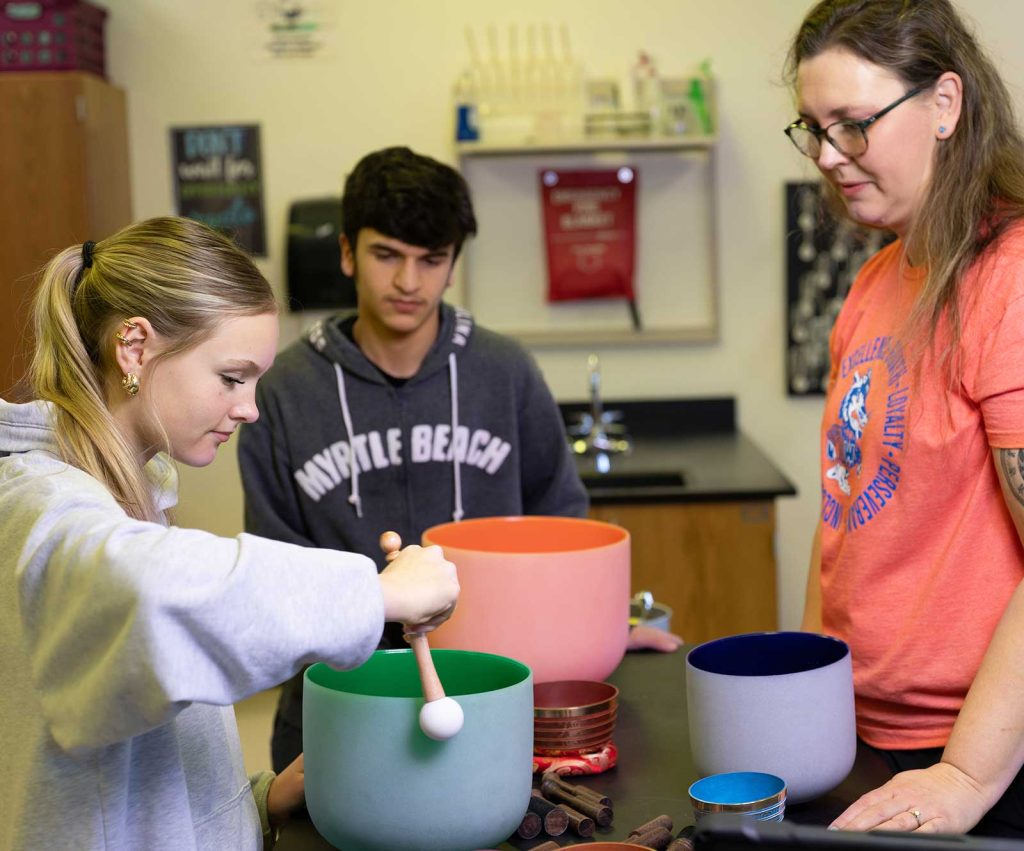
In physical science classes at Appleton West High School, students aren’t just learning about sound waves—they’re creating them.
Science teacher Julie Branner used a grant from the Appleton Education Foundation’s Alan and Vira Stoner Education Fund to purchase sets of Tibetan singing bowls to help students explore the relationship between wavelength, frequency, and wave speed in a hands-on, meaningful way.
Instead of simply reading about wave properties, her students now actively design experiments. By adding or removing water from the singing bowls to change pitch, students observe how frequency shifts and see the science of sound unfold before them.
Students collect and analyze data using Vernier sound sensors, revise their methods, if needed, and communicate their findings to Branner and to fellow classmates. Branner says this grant has given her a new way to spark student curiosity and engagement—all while fully aligning with district science standards.
Because the bowls and sensors are durable, non-consumable resources, this investment will impact approximately 200 students each year. The tools can also be shared with other science, health, and child-development classrooms, expanding opportunities for hands-on learning across the district for years to come.
Grant fact: AEF awarded a professional development grant in June 2025 to help high school science teachers strengthen their confidence and proficiency in using Vernier sensors and other equipment included in the district’s science curriculum. This leads to more meaningful hands-on learning experiences and deeper student understanding of scientific concepts.
This story first appeared in AEF’s 2025 Report to the Community in March 2026. Review the complete 2025 Report to the Community.